 DRIVINGO
Rules of the road
How Do You Use a Roundabout in New Zealand?
Published
How do you use a roundabout in New Zealand?
Slow down, give way to any vehicle that will cross your path from the right, and travel around the island clockwise, keeping it on your right. Then signal left once you are past the exit before yours, every time.
The part people argue about is the signal on the way in. It depends on where you are leaving.
When do you indicate at a roundabout?
| Where you are going | On the way in | On the way out |
|---|---|---|
| First exit, turning left | Signal left | Keep the left signal on |
| Straight through | No signal | Signal left once you pass the exit before yours |
| More than halfway around | Signal right | Signal left once you pass the exit before yours |
The exit signal is the one other drivers rely on. It tells the person waiting at the next entry that you are leaving and they can go.
Cyclists are excused from signalling on a roundabout, because holding an arm out through a turn is hard. Give them room and do not assume a missing signal means they are carrying on.
Who gives way at a roundabout?
You do, to anything coming from your right that would cross your path as you enter. In practice that means vehicles already on the roundabout and ones about to enter from the road to your right.
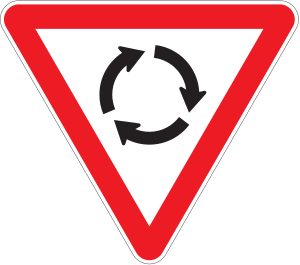
This sign at the entry means the roundabout rules apply. You do not have to stop if the way is clear, but you must be ready to.
How do you know a roundabout is coming?
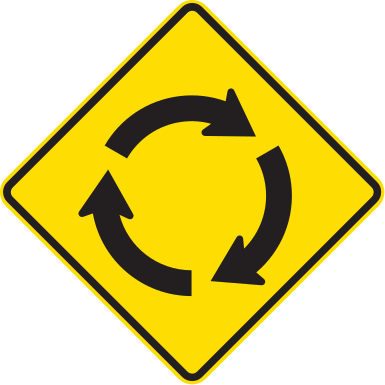
A yellow diamond with circling arrows warns you in advance. That is the moment to slow down and choose your lane, not when you reach the line.
A blue keep left arrow on the island at the entry shows which side of it to pass.
Which lane do you use on a multi-lane roundabout?
Follow the arrows painted on the road and the lane signs. Most larger roundabouts are marked, and the markings differ from one to the next, so read them each time and do not rely on habit.
Three things hold everywhere:
- be in the correct lane before you arrive
- give way to vehicles crossing from your right as you enter
- if you have to cross another lane to reach your exit, give way to vehicles in that lane
What should you watch for?
Large vehicles. A bus or truck may need more than one lane to get around, so do not sit alongside one through the turn.
Also watch for drivers changing lanes late to reach an exit, and anyone coming in too fast to hold their lane. A roundabout only works when people are predictable, which is the whole point of signalling.
What is the most common mistake?
Not signalling left on the way out. It is easy to forget once you are concentrating on steering, and it is the signal that keeps traffic flowing.
The second is treating the give way line as a stop line when the roundabout is empty, or as nothing at all when it is not. Slow enough to stop, look right, then go if it is clear.
The rules here come from the wider give way rules, and the signs are in our New Zealand road signs guide.
Get roundabouts right on paper first
Roundabout questions come up in the theory test, and the signalling table above is the part most people get wrong. Drivingo Road Code NZ lets you practise them with an AI coach explaining each answer. Get Drivingo Road Code NZ before you meet your first busy roundabout.
Written by Drivingo in our own words. Based on the New Zealand road code (2026), NZ Transport Agency Waka Kotahi, www.nzta.govt.nz. Traffic sign images © NZ Transport Agency Waka Kotahi.