 DRIVINGO
Rules of the road
What Are the Speed Limits in New Zealand?
Published
What are the speed limits in New Zealand?
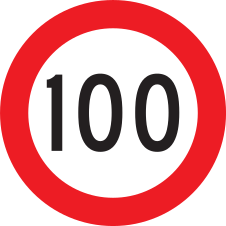
The open road limit is 100 km/h, and everywhere else the limit is whatever the red-ringed sign says. A limit is the fastest you may legally go in good conditions, so the right speed is often lower.
All New Zealand limits are in km/h.
What is the open road limit?
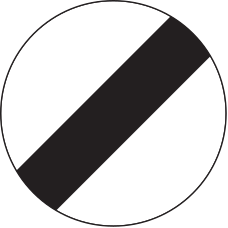
100 km/h for cars and motorcycles. Two signs mean it: the number 100 in a red ring, and a white disc crossed by a black diagonal bar.
Some vehicles have a lower maximum on the open road, whatever the sign says:
| Vehicle | Open road maximum |
|---|---|
| Cars and motorcycles | 100 km/h |
| Heavy vehicles (over 3500 kg) | 90 km/h |
| Light vehicles towing a trailer | 90 km/h |
| School buses over 2000 kg | 80 km/h |
| A vehicle towing another with a rope or other non-rigid link | 50 km/h |
So if you hire a trailer for the weekend, your limit drops to 90 km/h the moment you hitch it on.
What is the limit in towns?
Look for the sign. Limits in towns vary with the kind of street, so the number on the last sign you passed is the one that applies.
When must you drive at 20 km/h?
In two situations that learners often forget, and that the theory test likes.
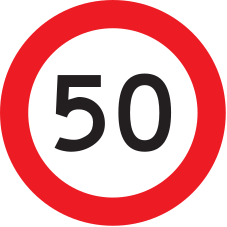
Passing a stopped school bus. If a school bus is stopped for children getting on or off, you pass at 20 km/h or less, whichever direction you are coming from. It applies whether or not the lights on the bus sign are flashing, and it lasts until you are well past.
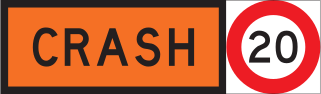
Passing a crash, fire or breakdown sign. Orange signs such as CRASH, ACCIDENT, FIRE, BREAKDOWN or EMERGENCY mean 20 km/h or less until you are beyond the site.
What about schools?
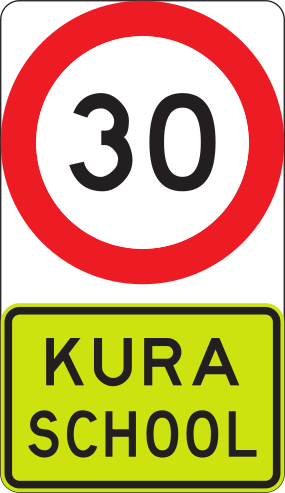
Many schools have their own limit, shown on signs outside. Some are fixed, some list the times they apply, and some are electronic and switch on around the start and end of the school day. When an electronic sign shows a number with its red ring flashing, that is the limit until the school zone ends.
Are there other special limits?
- Roadworks. A temporary limit, marked with an orange TEMPORARY plate, replaces the normal one. It applies even when nobody is working.
- Variable limits. Electronic signs, common on motorways, show a limit that changes with traffic or weather.
- Beaches and riverbeds. Where the sign is used, the limit is 60 km/h, falling to 30 km/h when pedestrians are present.
- Curves. A yellow plate under a bend sign gives a recommended speed. It is advice, not a limit, and it assumes good conditions.
Can you drive slower than the limit?
Yes, and often you should. Rain, fog, a narrow or winding road, pedestrians and cyclists nearby are all reasons to come down.
Two tests are worth remembering. You need room to pull up if the vehicle in front stops suddenly, and on a road with no centre line you need to be able to pull up within half the clear road you can see.
If you are holding up traffic, keep left and pull over when it is safe so others can pass. Speeding up on the straights to stop them passing is not allowed.
What happens if you go far over the limit?
Your licence is suspended for 28 days on the spot if police detect you at more than 40 km/h over a permanent limit, or more than 50 km/h over a temporary one. Lesser speeding brings demerit points, which add up quickly on a learner or restricted licence: see demerit points for learner drivers.
Each speed sign has its own page in our New Zealand road signs directory, and the road signs guide explains how to read them.
Know the numbers before the test
The limits, the 20 km/h rules and the towing maximums are all favourite test material. Drivingo Road Code NZ drills them with an AI coach explaining the ones you miss. Get Drivingo Road Code NZ and get the numbers to stick.
Written by Drivingo in our own words. Based on the New Zealand road code (2026), NZ Transport Agency Waka Kotahi, www.nzta.govt.nz. Traffic sign images © NZ Transport Agency Waka Kotahi.