 DRIVINGO
Road signs
What Do New Zealand Road Signs Mean?
Published
What do New Zealand road signs mean?
Every sign belongs to one of three types, and its colour and shape tell you which before you can read it. Red or blue signs give orders, yellow or orange signs warn you, and rectangular signs give information.
Learn that code first and the individual signs become easy, because most of them are pictures, the same symbols used around the world.
| Type | Looks like | What it tells you |
|---|---|---|
| Compulsory | Usually red or blue | Something you must do or must not do |
| Permanent warning | Yellow and black, mostly diamonds | A lasting hazard ahead |
| Temporary warning | Orange and black | A short-term hazard, often roadworks |
| Information | Rectangles in several colours | Directions, distances and services |
Which signs must you obey?
The red and blue ones. A red ring or red border sets a limit or bans something, and a blue disc tells you what you have to do.
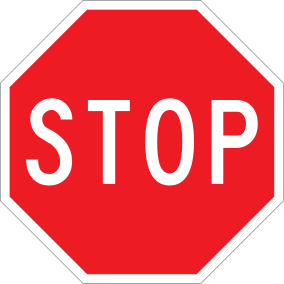
Stop is the only eight-sided sign, so you can recognise it from behind or under a coat of mud. It means a complete stop, then giving way to everyone.
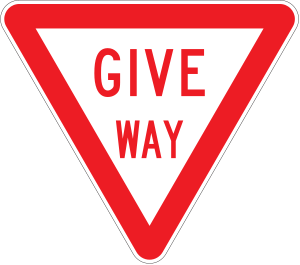
Give Way is the only triangle that points down. Slow down, be ready to stop, and let other traffic go first.
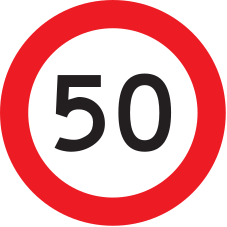
A number in a red ring is a speed limit in km/h. It is the most you may do in good conditions, not a target.
What do yellow diamond signs mean?
They warn of something permanent about the road: a bend, a roundabout, a narrow bridge, a crossing. Nothing is being ordered, but a warning sign is there because people have been caught out at that spot.
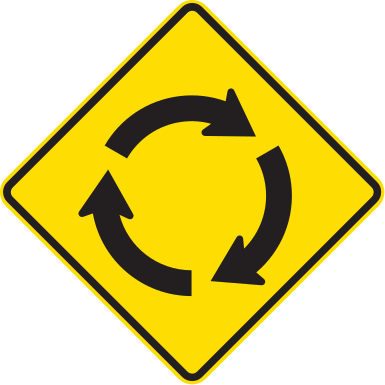
This one tells you a roundabout is coming, so you have time to slow down and pick a lane.
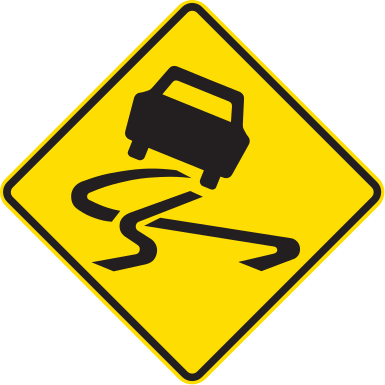
The skidding car means the surface can be slippery, most of all when it is wet or icy.
What do orange signs mean?
Orange means temporary. Someone put the sign out for roadworks, a slip, flooding or a crash, and will take it away afterwards.
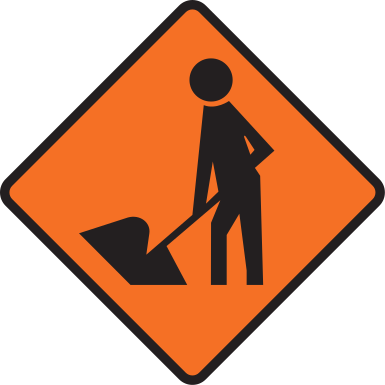
Treat orange signs with extra respect. They mark the places where the road is not how you remember it, and there are often people working a metre from your wheels. A temporary speed limit shown with them is every bit as binding as a permanent one.
What are the green, blue and white rectangles?
Information signs. Green ones mostly give directions and distances, and others point to services such as visitor information.
They ask nothing of you, but they do the most to keep you calm: a driver who knows the turn is 300 metres away has no reason to brake hard or swerve.
Why are some signs in two languages?
Some signs now carry te reo Māori alongside English. The one learners meet most is the school plate:
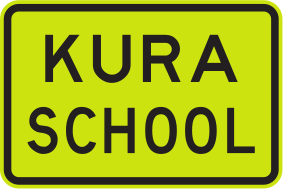
Kura means school. Under a speed limit or a children sign, it tells you why you are being asked to slow down.
How many signs do you need to know for the theory test?
Signs and road markings are one of the topics every learner is tested on, whichever licence they are going for. The good news is that the three-type code above lets you work out a sign you have never seen.
To go through them one at a time, our New Zealand road signs directory explains each sign and what to do when you see it. For the test itself, start with how the learner licence theory test works.
Test yourself on the signs
Reading about signs is slower than being quizzed on them. Drivingo Road Code NZ drills road signs alongside every other topic, with an AI coach explaining the ones you miss. Get Drivingo Road Code NZ and see how many you know on sight.
Written by Drivingo in our own words. Based on the New Zealand road code (2026), NZ Transport Agency Waka Kotahi, www.nzta.govt.nz. Traffic sign images © NZ Transport Agency Waka Kotahi.