 DRIVINGO
Rules of the road
Who Gives Way in New Zealand? The Give Way Rules Explained
Published
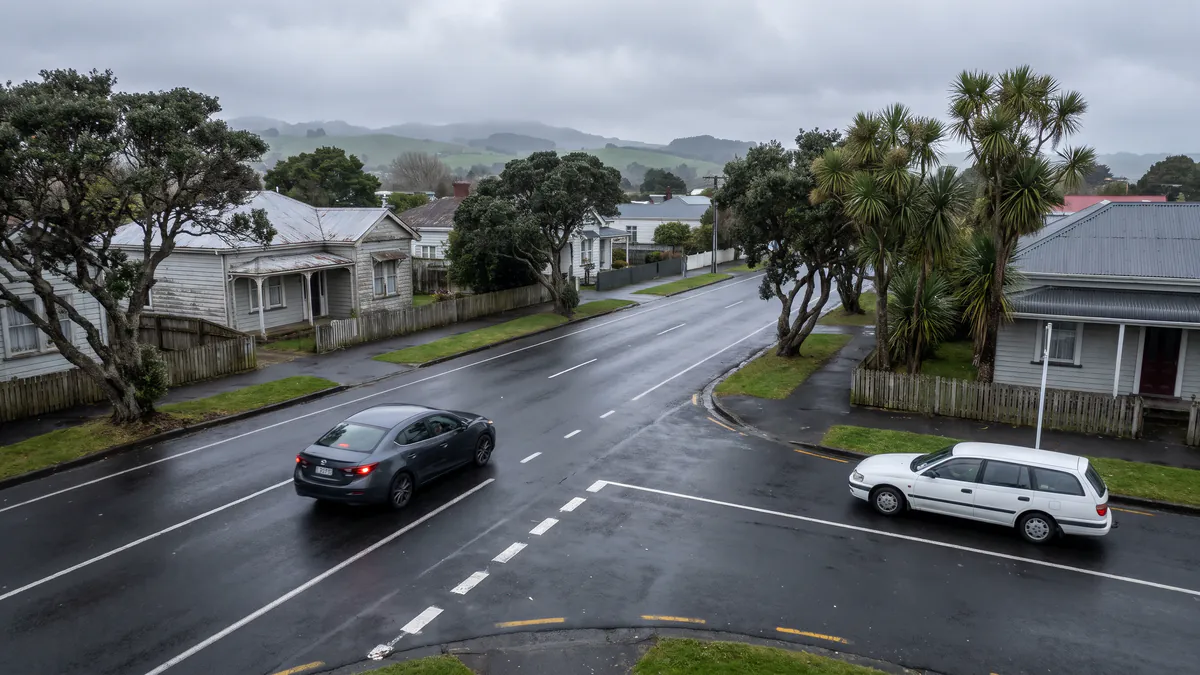
Who gives way in New Zealand?
If you are turning, you give way to traffic that is not. That one idea settles most situations, and three more rules cover the rest: a right-turner gives way to a left-turner, the bottom of a T gives way to the top, and when nothing else applies you give way to your right.
Signs and signals come first. A stop sign, a give way sign or a red light always beats the rules below, and a police officer directing traffic beats everything.
What are the four rules?
| Situation | Who gives way |
|---|---|
| One vehicle turning, one going straight | The one turning |
| Both turning into the same road, one right and one left | The one turning right |
| T-intersection or driveway | Traffic on the road that ends |
| None of the above | Give way to vehicles from your right |
The second rule only applies when both drivers face the same thing: no signs at all, or the same sign, or the same green light.
What counts as turning?
More than you might think. If the centre line bends away and you carry on along a different road, you are leaving the path of the centre line, and the law treats that as a turn even though your steering wheel barely moves.
So on a road that curves at an intersection, the driver following the line has priority over the driver heading straight off it.
What happens at a T-intersection?
The road that ends gives way to the road that carries on. If you are on the stem of the T, everyone on the top of the T goes before you, whichever way you are turning.
Driveways work the same way. Coming out of one, everything already on the road goes before you, and so does anyone on the footpath, cycle path or shared path you cross.
What do stop and give way signs change?

At a stop sign you stop completely, where you can see, and stay there until the way is clear of everything, bikes and motorbikes included.
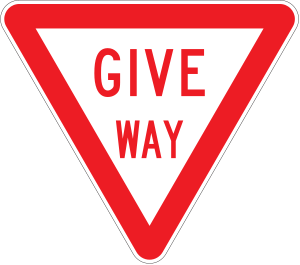
At a give way sign you slow down and get ready to stop, and you go only when it is safe.
The two signs are not equal. A driver at a stop sign gives way to a driver at a give way sign. When two drivers face the same sign, the four rules above decide between them.
What if two cars facing each other both turn right?
Usually nobody has to wait, because the two paths do not cross. Watch for a truck or bus that needs extra room, and look past the turning vehicle for anything coming straight through behind it.
Who gives way at traffic lights?
A green light lets you go, but it does not clear your path. Turning right on green, you still give way to oncoming vehicles going straight or turning left, and to pedestrians crossing the road you are turning into.
If the lights have failed and are flashing yellow, treat the intersection as if it had no signals and use the give way rules.
Who else do you give way to?
- Cyclists and e-scooter riders in a cycle lane, and vehicles in a bus lane, when you turn across them.
- Buses pulling out from a stop, the roadside or a bus lane, on roads with a limit of 60 km/h or less. The driver has to indicate for at least three seconds first.
- Traffic already on a roundabout coming from your right. Our guide to using a roundabout covers the signalling.
The rule behind the rules
Giving way means the other road user should not have to brake, swerve or stop because of you. If you are unsure, wait. Being right is not much comfort in a crash.
Give way questions make up one of the biggest parts of the theory test, so they repay practice. See how the theory test works, and the road signs guide for the signs that control intersections.
Practise until it is automatic
Give way decisions have to be instant on the road. Drivingo Road Code NZ gives you intersection questions with an AI coach explaining who goes first and why. Get Drivingo Road Code NZ and make the four rules second nature.
Written by Drivingo in our own words. Based on the New Zealand road code (2026), NZ Transport Agency Waka Kotahi, www.nzta.govt.nz. Traffic sign images © NZ Transport Agency Waka Kotahi.