 DRIVINGO
Rules of the road
How Do You Go Around a Roundabout in Ireland?
Published
How do you go around a roundabout in Ireland?
Picture the roundabout as a clock, with you arriving at 6 o'clock. For any exit from 6 round to 12 o'clock (left or straight ahead), approach in the left-hand lane. For any exit after 12 o'clock (to the right, or going back the way you came), approach in the right-hand lane. Always yield to traffic coming from your right, go round clockwise, and follow lane markings if they tell you something different.
That's the RSA's "golden rule", and it works on almost any roundabout in the country, from a quiet two-exit one in a village to the multi-lane monsters on the edge of every big town.
The golden rule
Imagine a clock face on the roundabout, with you arriving at 6 o'clock:
- Exit between 6 and 12 o'clock (left or straight on): come in using the left-hand lane.
- Exit after 12, back round to 6 (right, or a U-turn): come in using the right-hand lane.
- Lane markings come first. Where arrows on the road show which lane to use, follow them.
Heavy traffic or a blocked lane can force a different line now and then, but most days the clock gets you round safely.
The beauty of the clock is that you don't need to count exits or know how many there are. You only need to know whether your exit is before or after the top of the clock.
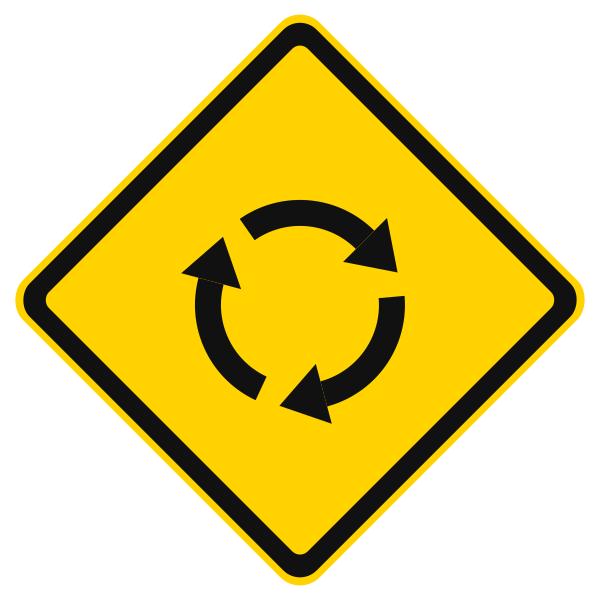
When you see this yellow warning sign, that's your cue to work out where your exit is on the clock and get into the right lane early. Swerving across lanes at the last second is how roundabout bumps happen.
Approaching any roundabout
Whatever exit you're taking, the approach is the same:
- Look for lane arrows, road markings and signs. If the road tells you which lane to use, do what the road says; it overrides the clock.
- Get into the correct lane in good time.
- Treat it as a junction. Yield to traffic coming from your right and to anyone already on the roundabout.
- Keep moving if it's clear. Stopping at an empty roundabout "just in case" confuses the driver behind and costs you marks on the driving test for hesitation.
Entering a roundabout by turning anywhere other than left is an offence too, with a fine and a penalty point. Clockwise only.
Turning left (the first exit)
The simplest one. Left lane, indicate left as you approach and keep indicating until you've left the roundabout at the first exit.
Going straight ahead (any exit up to 12 o'clock)
Left lane on the approach (unless the markings say otherwise), and no signal on the way in. As you pass the exit before the one you want, indicate left and take your exit.
Example: you're at 6 o'clock and your road is at 12 o'clock, straight across. Approach in the left lane, no signal. Once you pass the 9 o'clock exit, indicate left and leave at 12.
Sometimes the left lane is a long queue of traffic all turning left, or blocked by roadworks. In that case the Rules of the Road accepts that you may need to take a different line to your exit (it shows the alternative course in a diagram). Do it carefully, with good observation, and signal clearly.
When you leave, take a good look for cyclists and motorcyclists, who may be carrying on round the roundabout on your left.
Turning right or going back (exits after 12 o'clock)
This is the one people get wrong.
- Right lane on the approach (unless markings say otherwise).
- Indicate right as you approach, and keep that signal on as you go round.
- When you pass the exit before yours, switch to indicating left.
- Move over to the left carefully, checking your mirrors and blind spot, and leave.
Example: from 6 o'clock to an exit at 3 o'clock. Right lane, indicate right, go past 9 and 12, switch to left after 12, ease across and exit at 3.
The common mistakes are forgetting to switch from right to left (so everyone waiting thinks you're staying on), or cutting across the left lane without checking it.
Mini-roundabouts
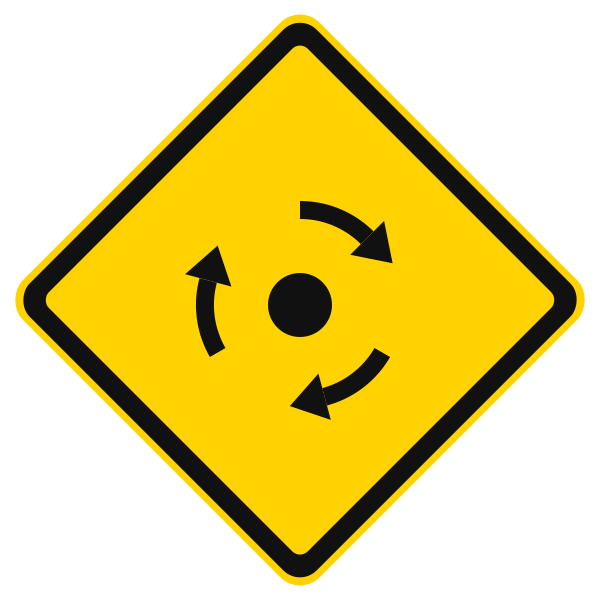
Mini-roundabouts are the small ones with a painted or slightly raised centre, often found in towns and estates as part of traffic calming. The yellow sign above warns you one is coming. At the junction itself you'll see the blue regulatory sign:
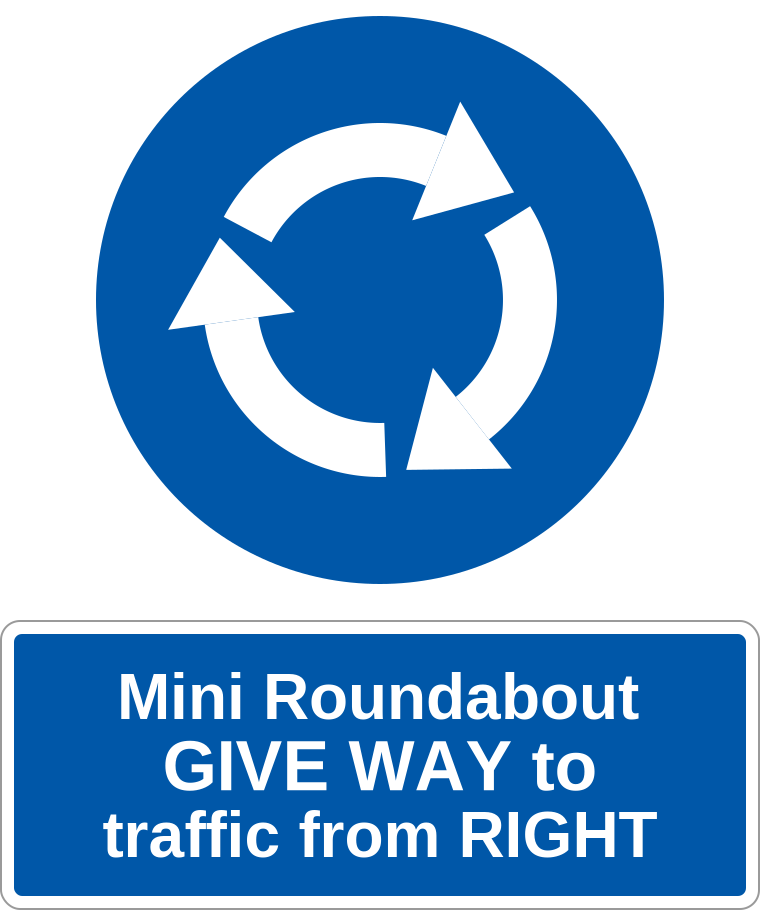
The same principles apply: give way to traffic from your right and go round clockwise. There's less room, so signal early and expect other drivers to be unsure. Breaking the rules at a mini-roundabout is a fixed charge offence: €60 and 1 penalty point. That point matters more than it sounds if you're a learner or novice; see penalty points for learner and novice drivers.
Watch out for cyclists, horse riders and long vehicles
Roundabouts are where other road users' rules meet yours, so keep plenty of room for:
- Pedestrians crossing the roads going into and out of the roundabout.
- Cyclists and horse riders, who are allowed to keep to the left lane and signal right if they're going all the way round. That's allowed. Don't squeeze past them.
- Motorcyclists, who are easy to miss when you're looking for cars.
- Long vehicles and anything towing, which may need to take an odd line, straddle lanes or use more of the roundabout. Watch their signals and hang back.
- Traffic in the wrong lane. Not everyone has read this article. Expect someone to cut across you.
The RSA's advice to cyclists says much the same from the other side: drivers may not see you easily, so take care crossing exits, and give long vehicles the space they need.
Roundabouts in the theory test and driving test
Roundabouts come up in the Driver Theory Test because they mix lanes, signals and right of way in one place. On the driving test, the tester watches your lane choice, signals, observation and whether you keep moving when it's safe. We go through everything the tester marks in what happens on the driving test in Ireland. For the signs around roundabouts and everywhere else, see what Irish road signs mean.
Roundabouts at a glance
| Your exit | Approach lane | Signal on approach | Signal to leave |
|---|---|---|---|
| First left | Left | Left | Keep left on |
| Straight ahead (up to 12 o'clock) | Left | None | Left, after passing the exit before yours |
| Right or back (after 12 o'clock) | Right | Right | Switch to left after passing the exit before yours |
Master the rules before the roundabout
Drivingo DTT Ireland covers roundabouts, junctions and right of way along with every other theory topic, with mock tests against the 35-out-of-40 pass mark. Download Drivingo DTT Ireland and get the rules right on paper before you meet them on the road.
Written by Drivingo in our own words. Based on Rules of the Road (Revision No. 9: May 2026), Road Safety Authority (RSA), www.rsa.ie.