 DRIVINGO
Driving test
What Happens on the Driving Test in Ireland?
Published
What happens on the driving test in Ireland?
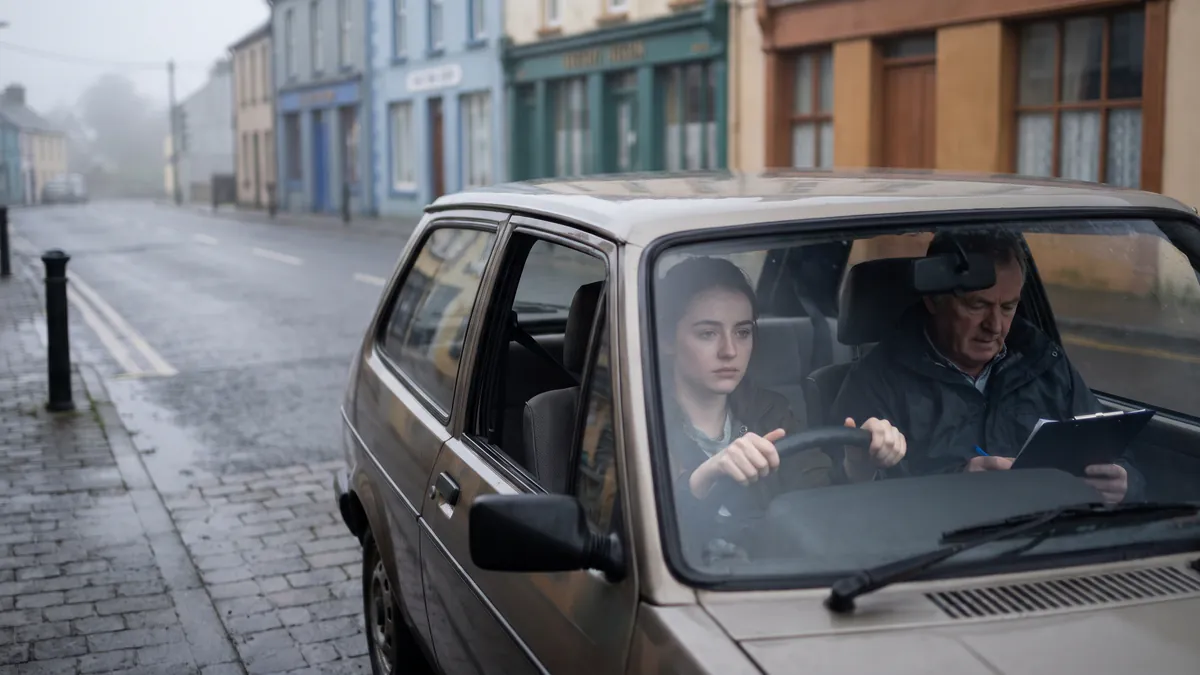
The car driving test takes about 40 minutes and covers roughly 8 to 10 km of real roads. A driver tester from the RSA checks your permit, quizzes you on the rules and on how the car works, gets you to show some technical checks and secondary controls, then watches you drive in normal traffic, including reversing, a turnabout and parking. You get the result at the end.
That's the day itself. Getting to that day has a few conditions first, and missing one of them can cost you the test and the fee.
When can you book the driving test?
For a car, you need all three of these:
- A current learner permit for the category you're being tested in. The road there starts with getting your learner permit.
- Six months on your first permit. On test day, a first-time car learner's permit must be at least six months old.
- EDT completed. If you got your first car permit from 4 April 2011 onwards, all 12 Essential Driver Training lessons must be done. See what EDT is and how it works.
You also need a suitable car, which we'll come back to.
How do you apply?
You apply and pay online at rsa.ie with a debit or credit card and an email address. A paper application is also possible. The current test fee and the typical wait for a test date are both on rsa.ie; we're not quoting either here because they change, and the wait in particular varies a lot between test centres.
What do you need on the day?
The appointment notice the RSA sends you is the final word on what to bring, so read it properly. The main points:
- Arrive at least 10 minutes early. Late means no test.
- Bring your current Irish learner permit. The tester checks it's yours, it's valid and it's for the right category.
- Bring a suitable car. It has to meet the RSA's minimum requirements for a test vehicle; the details are on your appointment notice and on rsa.ie.
- Discs on display: current motor tax, a valid NCT disc and a current insurance disc.
- L plates front and back. Proper ones. (Our guide to L plates and N plates has the size rules.)
- A roadworthy car. Tyres, lights, indicators, the lot.
Your test is cancelled and you lose the fee if you're late, the discs or L plates aren't right, the car isn't roadworthy, or it isn't a suitable vehicle for the test. That's an expensive way to find out a bulb has gone, so walk around the car the night before.
What happens during the test?
Questions and checks
Before you drive, the tester will ask you a few things: some on the rules, some on how your car works. You'll also be asked to:
- work the secondary controls: things like the wipers and washers, demisters, rear window heater, lights, fog lights, fans, air vents and air conditioning;
- show technical checks: for example tyre condition and pressure, oil, coolant, washer fluid, brakes (handbrake included), steering, lights, indicators, reflectors and the horn.
The RSA's Driving Test Report Form describes these checks in detail. Read it well before the day so that "show me how you'd check the oil" isn't a surprise.
You'll also be expected to set up the car properly: seat, seat belt, head restraint and mirrors adjusted, doors closed.
The drive
Then you drive, on a route that takes in different roads and traffic conditions. The tester uses an electronic device to note faults as you go. They're marking you under headings including:
- observation, and using your mirrors in good time, before you signal;
- position on the road, in good time;
- signals that are correct and given at the right moment;
- hazards: reacting promptly and sensibly;
- clearance: giving pedestrians, cyclists and other road users enough room;
- progress: keeping moving at a reasonable pace and not hesitating when it's safe to go, for example at roundabouts or changing lanes;
- speed: adjusting it to the conditions;
- traffic controls: obeying lights, signs and road markings;
- right of way: yielding when you should;
- vehicle controls: using them properly;
- and the set manoeuvres: reversing, a turnabout and parking.
Roundabouts deserve a special mention, because they combine almost every heading on that list at once. If they make you nervous, read our roundabout rules guide and practise them until they're boring.
How long does the driving test last?
Roughly 40 minutes for a car (category B), with somewhere between 8 and 10 km of actual driving. Motorbikes (AM, A1, A2 and A), car and trailer (BE) and work vehicles (W) get the same length of test. Trucks and buses take longer: around 70 minutes over about 20 km.
So for a car, plan on about 40 minutes of the test plus time at the centre before and after.
What happens when the test is finished?
The tester tells you the result, and you also get an email about it. Go through it with your instructor either way.
If you pass
You get a Certificate of Competency. Swap it for your full licence through the NDLS as soon as you can; you must do it within two years of the certificate date. Then the N plates go on for two years, and as a novice you still can't accompany a learner.
If you don't pass
You get a detailed report of the faults from your test. Treat it as a to-do list: work on those areas with your ADI and your sponsor, without letting the rest of your driving slip, and book again.
If you believe the test wasn't carried out properly or fairly, you can appeal to the District Court. If the court agrees, it can order the RSA to give you a fresh test at no cost.
Driving test tips that actually help
- Do a mock test with your ADI on roads near the test centre.
- Over-observe. Make your mirror checks and head checks obvious.
- Don't freeze on progress. Waiting too long when it's safe to go is marked too.
- Listen to the instruction, then ask if unsure. Asking the tester to repeat something is fine.
- Check the car the night before: discs, L plates, lights, tyres.
Start at the beginning: the theory test
The driving test is the last step, and the Driver Theory Test is the first. Drivingo DTT Ireland gets you through the DTT with practice on every topic, mock tests against the 35-out-of-40 pass mark and explanations that make the rules stick for the drive too. Download Drivingo DTT Ireland and get the journey started.
Written by Drivingo in our own words. Based on Rules of the Road (Revision No. 9: May 2026), Road Safety Authority (RSA), www.rsa.ie.