 DRIVINGO
Rules of the road
What Are the Speed Limits in Ireland?
Published
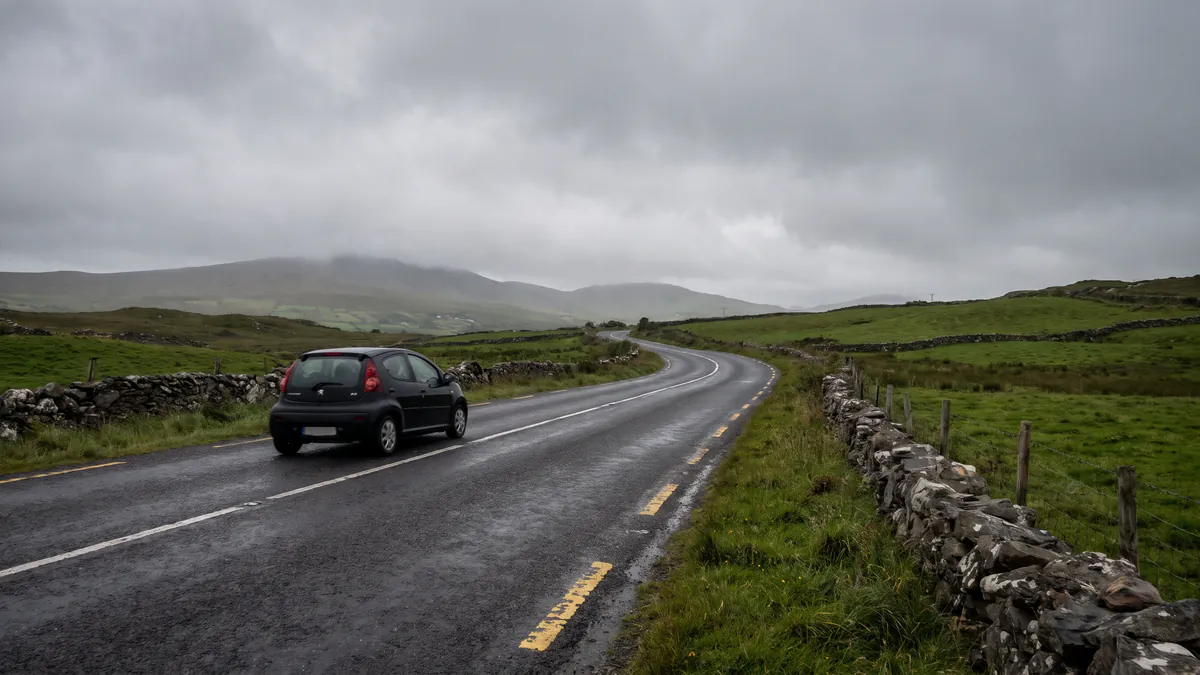
What are the speed limits in Ireland?
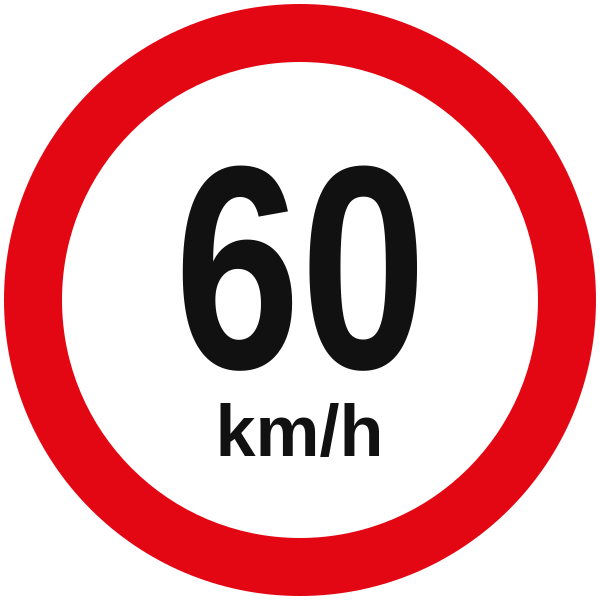
The default speed limits in Ireland are 120 km/h on motorways, 100 km/h on national roads and dual carriageways, 80 km/h on regional roads, 60 km/h on rural local roads and 50 km/h in built-up areas. A posted sign always beats the default, so if a sign shows a different number, that's your limit.
That's the short version. The longer one matters because Irish limits changed in 2025 and more changes are on the way, so a few of the numbers you'll find in older guides (and older apps) are now wrong.
Irish speed limits at a glance
| Type of road | How to recognise it | Default limit |
|---|---|---|
| Motorway | M roads, blue signs | 120 km/h |
| National road (primary and secondary) and dual carriageway | N roads, green signs | 100 km/h |
| Regional road | R roads, white signs | 80 km/h |
| Rural local road | L roads, often narrow, white signs | 60 km/h |
| Built-up area | Towns, cities, villages | 50 km/h |
| Special limits | Wherever a sign says so | 30 km/h, 60 km/h and others |
These figures are checked against the Citizens Information page on speed limits as of 31 October 2026. Speed limits are under review, so always trust the sign in front of you over any table, this one included.
What exactly is a speed limit?
A speed limit is a ceiling for one stretch of road, and there are two kinds: limits set for roads (on a sign, or the default for that type of road) and limits set for types of vehicle (trucks and buses have lower ones).
Either way, the number on the sign is the most you may do in good conditions, not a speed you have to reach. On a wet, winding road in the dark, the safe speed can be far below the limit and driving at the limit there is still driving too fast.
How do you know which road you're on?
Ireland doesn't put the default limit on a sign at every bend, so you need to read the road. Direction signs are the quickest clue:
- Blue signs mean a motorway (M1, M50 and so on).
- Green signs mean a national road (N roads, such as the N7 or N59).
- White signs mean a regional (R) or local (L) road.
Our guide to what Irish road signs mean covers the colours in more detail. Road numbers help too: they're often printed on the direction signs themselves.
What changed in 2025?
The big one: rural local roads dropped from 80 km/h to 60 km/h on 7 February 2025. These are the L roads: the narrow country roads and boreens where 80 km/h was often far too fast anyway.
That change also changed the meaning of this sign:
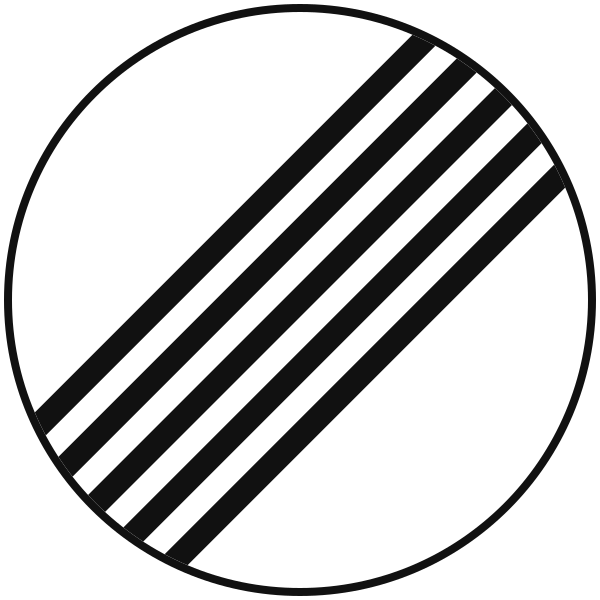
A white disc with five black diagonal lines is the rural speed limit sign. You'll usually see it where a local road leaves a town, sometimes with a "Go Mall / Slow" plate underneath. It used to mean 80 km/h. It now means 60 km/h. If you learned it as 80, unlearn it; it's exactly the kind of detail the theory test can pick up.
What's planned but not in force yet
The Road Traffic Act 2024 also allows the default on national secondary roads to be cut from 100 km/h to 80 km/h. As of 31 October 2026, that part is not in force, and no start date has been announced. Until it is, national secondary roads stay at 100 km/h unless a sign says otherwise. Keep an eye on the signs: when it changes, it'll change overnight.
50 km/h in towns, and the move to 30
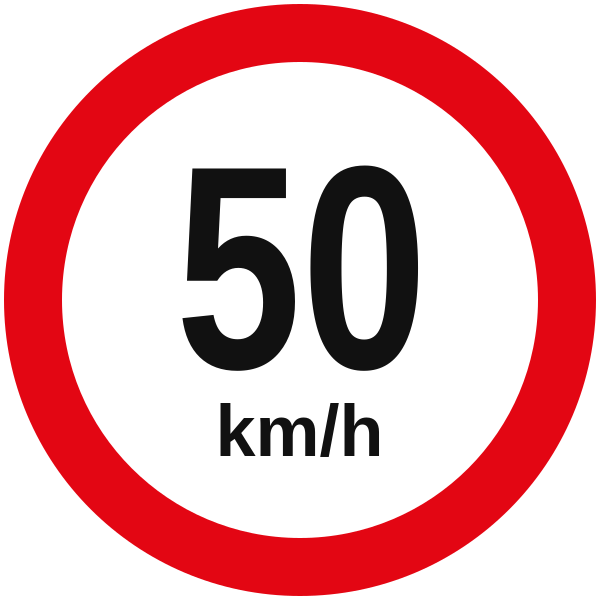
Inside a built-up area (a city, town or village), the default is 50 km/h.
Councils are now bringing in 30 km/h limits by local bye-law in town and city centres, housing estates and around schools, with a target of having them in place by 31 March 2027. Because each council sets its own, the picture varies from town to town: one estate might be 30 km/h while the next is still 50 km/h.
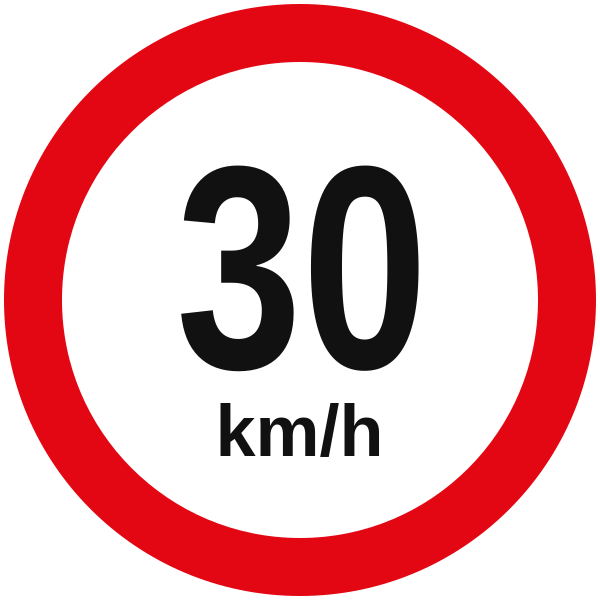
The rule of thumb for learners: in a town, assume 50 km/h unless you see a lower sign, and look out for 30 km/h signs at the entrance to estates and school zones.
Special, periodic and variable limits
Councils can set special speed limits on any stretch of road by bye-law, for example 60 km/h on the approach to a town, or a lower limit on a dangerous section.
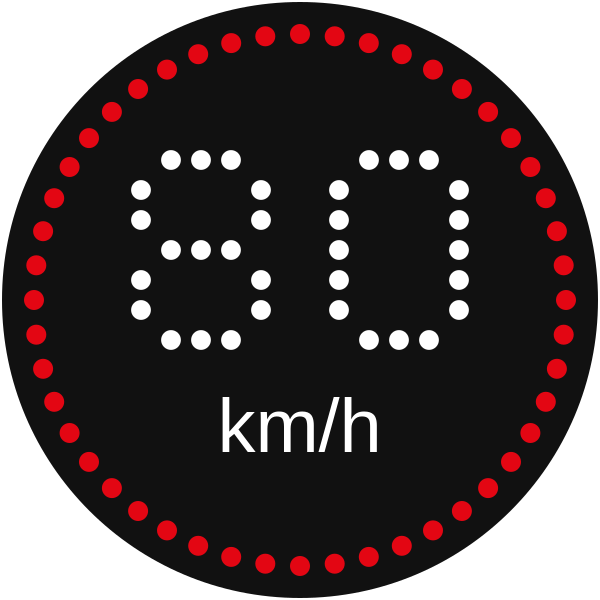
Some limits only apply at certain times. Periodic limits near schools often use an electronic sign that lights up during school arrival and home time and goes blank the rest of the day. While it's lit, the lower number is the limit.
On some busy roads, such as parts of the M50 around Dublin, variable speed limits change with traffic and conditions. The limit is whatever the overhead or roadside electronic sign shows at that moment.
And at roadworks, temporary limits apply too. Whatever the default for the road, a posted sign always overrides it.
Can learners drive at 120 km/h?
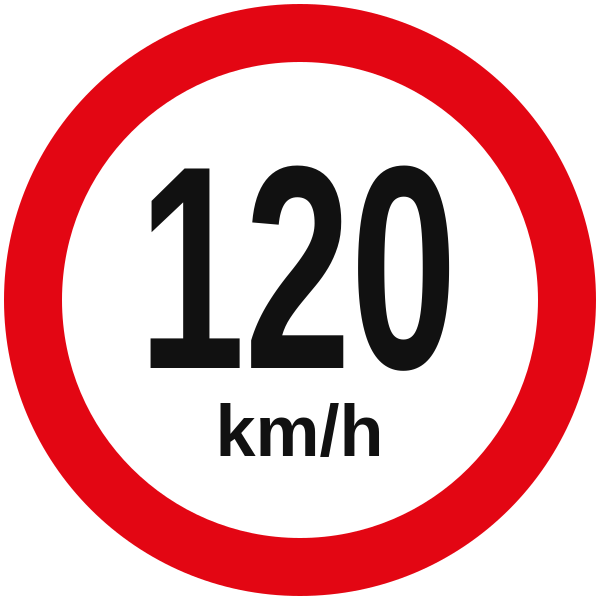
No, because learners can't use motorways at all. A learner permit holder is banned from motorways until they pass the driving test, so the 120 km/h limit is one you'll only meet once you've got your full licence.
Everywhere else, learners follow the same limits as everyone else. There's no separate "learner limit". The rules for learner permit holders, including the motorway ban, are in our learner permit guide.
A note on vehicles
Some vehicles have their own, lower limits regardless of the road. The one most car drivers will meet: if you're towing a trailer or caravan, your limit is 80 km/h on any road. Trucks and buses have their own limits too, and when the vehicle limit and the road limit differ, the lower one applies.
How much does speeding cost?
Speeding is a fixed charge offence:
| When you deal with it | Fine | Penalty points |
|---|---|---|
| Paid within 28 days | €160 | 3 |
| Paid in the next 28 days | €240 | 3 |
| Not paid, goes to court | Up to €1,000 | 5 on conviction |
Three points sounds manageable until you remember that learner and novice drivers are banned at 7 points, not 12. Two speeding offences and a third minor one, and you're off the road for six months. The full story is in penalty points for learner and novice drivers.
Why the limits are what they are: stopping distances
Speed limits make more sense once you know how far a car travels before it stops. The RSA's figures for a car on a dry road:
| Speed | Total stopping distance (dry) |
|---|---|
| 50 km/h | 25 m |
| 80 km/h | 52 m |
| 100 km/h | 70 m |
| 120 km/h | 102 m |
On a wet road, every one of those gets much longer. At 100 km/h you need around 70 metres to stop in the dry, which is why 100 km/h on a narrow, twisty L road was never a good idea, and why the limit there is now 60.
Speed limits in the theory test
Speed questions are some of the easiest marks in the Driver Theory Test: learn the defaults, the signs and the stopping distances, and you'll have them. Just make sure your numbers are up to date (60 on rural local roads, not 80).
Drivingo DTT Ireland covers speed limits, signs and stopping distances along with every other theory topic, with mock tests against the 35-out-of-40 pass mark. Download Drivingo DTT Ireland and get the numbers into your head before you get them onto the road.
Written by Drivingo in our own words. Based on Rules of the Road (Revision No. 9: May 2026), Road Safety Authority (RSA), www.rsa.ie.